

Introduction – A Living Legacy of Learning
Standing in the eastern Indian state of Bihar is a place that whispers of a time when knowledge was worshipped, pilgrimage meant scholarship, and the world’s greatest minds gathered to learn and debate: Nalanda. For centuries, the ancient site now called Nalanda was the heart of an education system that drew students from across Asia. Today, the ruins of the ancient monastic university remain a powerful testament to India’s heritage of scholarship, religion and culture. If you’re planning a journey, this guide will help you explore Nalanda’s past, understand its significance, navigate the remains, and experience what makes this place truly extraordinary.
1. Historical Significance – The First Residential University
The story of Nalanda begins long ago. Located near present-day Bihar Sharif in Nalanda district, Bihar, the original institution known as the Nalanda Mahavihara was an educational and monastic complex that flourished from the 5th century CE into the 12th century.
It was perhaps the world’s first large-scale residential university — scholars not only studied but lived here; students came from long distances, including China, Korea, Japan, Tibet, Sri Lanka and beyond.
During its heyday, Nalanda was patronised by rulers such as Emperor Kumaragupta I (4th-5th century) and the Gupta empire, and later by Harshavardhana (7th century).
The academic curriculum went far beyond religious studies: Buddhist philosophy, logic, grammar, medicine, metaphysics, astrology and more were taught.
The site’s location, deep in the Magadha region of ancient India, made it part of the intellectual and spiritual landscape of the time. It wasn’t only a place of learning—it was a living, vibrant community of scholars.
2. Architecture & Layout – What Remains Today
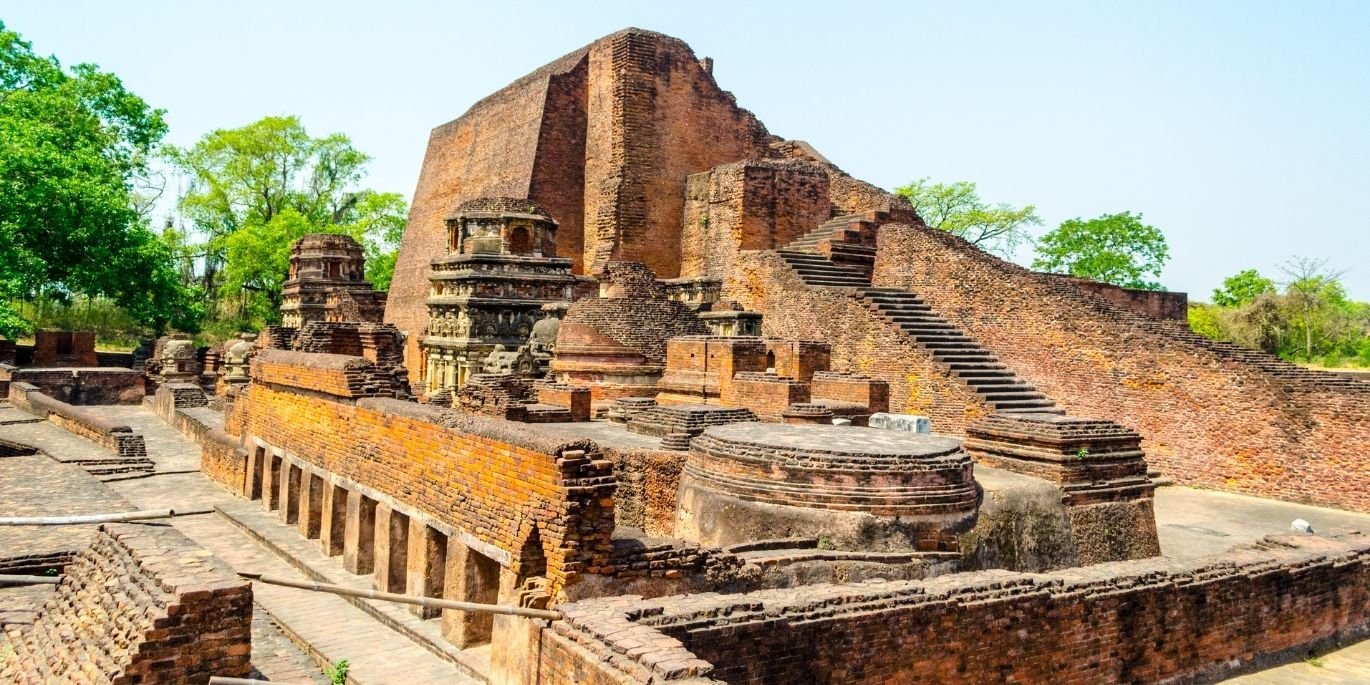
Visiting Nalanda means stepping into the archaeological remains of a once-grand university. The site includes viharas (monastic dwellings), temples, stupas, libraries and lecture halls.
Some of the key features to notice:
- The ruin panels show the scale: There are at least 11 major viharas and 14 temples within the core site
- The layout is planned along a north-south axis, with large open courtyards, colonnaded walkways and stone-carved imagery.
- Imported ideas meet local craftsmanship: stucco and stone work, Buddhist iconography, monastic cell patterns.
- The “Great Stupa” and various shrines: these remain focal points for visitors exploring the remains.
Walking through the site, one can imagine the bustling campus it once was monks debating in open arcades, students writing scrolls, libraries full of manuscripts. While much has been lost, the ruins evoke that living atmosphere of scholarship.
3. Why Nalanda Matters – Beyond the Ruins
Nalanda’s significance goes far beyond its physical remains. It represents ideas that are timeless: the pursuit of knowledge, cross-cultural exchange, religious co-existence and the global flow of ideas.
- It served as a model for later monastic-universities in Asia, especially in Buddhist countries.
- The fact that scholars from so many lands came here underscores its global importance centuries ago.
- Today, Nalanda is designated a UNESCO World Heritage Site.
- For the traveller, Nalanda isn’t just another heritage site—it is a chance to connect with an intellectual legacy, to stand where ideas were born and spread.
4. Planning Your Visit – What to Know
Location & How to Reach
Nalanda is located approximately 90 km southeast of Patna and is accessible by road and rail.
Nearest major airport: Patna (Jayaprakash Narayan Airport) or Gaya (for regional access).
By train: You can reach the Nalanda railway station; local transport connects you to the heritage site. By road: Regular bus or taxi services from Patna, Gaya and other nearby towns.
Best Time to Visit
The ideal period is from October to March when the weather is moderate and comfortable for exploring ruins. Avoid extreme summer heat. Arrive early in the morning to avoid crowds and catch softer light for photography.
Entry & Access
There is an entry fee for the archaeological site; check current rates. Carry water, sun-hat, comfortable footwear (the ground is uneven in places).
Dress modestly—though it is not a religious site in active use, respect the heritage.
5. What to See & Do
Main Site – Nalanda Ruins
Start with the main archaeological complex of the Nalanda Mahavihara. Walk the perimeter, visit the museum (often on-site), view the viharas and temple ruins, the library foundations, the stupas.
Hiuen Tsang (Xuanzang) Memorial Hall
Built to commemorate the famous Chinese monk-traveller (7th century) who studied at Nalanda, the memorial hall contains statues, exhibits and a chance to dive deeper into the cross-cultural linkages.
Pawapuri & Other Nearby Heritage
Pawapuri (in the Nalanda district) is important in Jain tradition—worth a side visit if your time allows. Other sites in Nalanda district: Rajgir, the Vishwa Shanti Stupa, ancient caves.
Explore the Town & Surroundings
Take time to stroll through the town of Nalanda / Bihar Sharif, observe local life, sample regional cuisine, perhaps visit local markets. Stay overnight if you can to absorb the atmosphere.
6. Culture, Interpretation & Visitor Tips
- Hire a local guide or audio-guide at the ruins for richer context. Without explanation, the stones whisper but you may miss the full story.
- Photography: Bring your camera but be aware of restricted zones. Drones likely not allowed without permission.
- Respect the site: It is an archaeological monument. Avoid climbing on fragile remnants, stick to marked paths.
- Early morning light is magical on the stone ruins: Consider arriving just after sunrise.
- Pack snacks and water, wear good shoes—the terrain is uneven, and there’s limited shade in parts.
- Combine your visit with nearby heritage spots for a fuller experience.
7. Interesting Facts and Storylines
- The Nalanda site functioned for about eight centuries from 5th century CE until around 1200 CE.
- It is widely described as the world’s first residential university, where students lived on campus.
- Its library, the so-called Dharmaganja or “House of Books”, was said to house millions of manuscripts and scrolls.
- The Chinese pilgrim Xuanzang (Hiuen Tsang) journeyed here and left detailed records of student life, lectures and the library.
- While the ruins today show only a fraction of what once existed, the impact of Nalanda resonates in scholarship and the global spread of Buddhism.
- The revival of a modern institution, Nalanda University (2010-onwards) aims to bring the spirit of the ancient university into the 21st century.
8. Why Nalanda Should Be on Your Travel List
If your travel aims include heritage, depth, perspective and reflection, Nalanda offers something unique. Unlike a typical fort or palace, Nalanda invites you into the intellectual and spiritual past of India—into a place where knowledge was revered.
For students of history, Buddhism, archaeology or just curious travellers, it’s a rare chance to stand among the ruins of one of the world’s earliest centres of learning.
It also complements nearby pilgrimage and heritage destinations in Bihar, making it perfect for a longer heritage-tour itinerary.
9. Suggested Itinerary & Stay Options
One-Day Visit: Arrive in early morning, spend half a day at the ruins with a guide, afternoon visit Hiuen Tsang Memorial, evening stroll/town exploration.
Two-Day Visit: Stay overnight at a heritage hotel or guest-house in Nalanda district, use the next morning for nearby attractions like Rajgir, Pawapuri or even Bodhgaya if time allows.
Multi-Day Heritage Loop: Combine Patna → Nalanda → Rajgir → Bodhgaya → Varanasi for a deep dive into ancient India’s spiritual and academic heritage.
Accommodation ranges from simple guesthouses to better-equipped hotels near main site; book in advance during peak travel season (Oct-Mar).
10. Closing Thoughts – A Journey Worth Taking
Visiting Nalanda is more than ticking a landmark off your list—it’s stepping into a world where learning, faith and culture intersected centuries ago. As you walk among the ancient brick-ruins, reflect on the fact that students arrived here from far lands, monks debated in halls now fallen silent, and knowledge spread across Asia from this very ground.
Take your time. Let the place sink in: the stillness, the stones, the legacy. Let Nalanda be a moment of pause in your travel journey—a place where you don’t just see, you feel the past.